



On Monday at 10:45 AM Eastern time, the Orion capsule will fly within 4,600 miles of the Moon's surface, marking its closest approach to our satellite. The lunar gravity will pull the spacecraft around the far side of the Moon and send it on a "free-trajectory" return to Earth. They will splash down in the Pacific Ocean on Friday.
Since we can't be there with them, the crew — like all astronaut crews who have traveled to the Moon since the 1960s — is taking thousands of pictures.
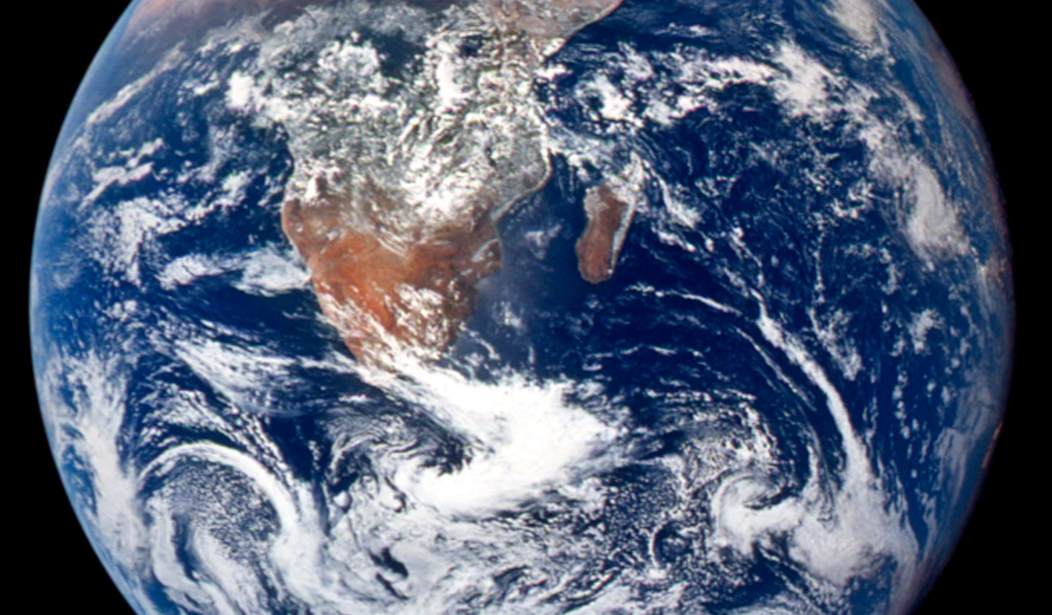
Truthfully, I wasn't expecting much. You've seen one spectacular view of Earth from space, you've seen them all, right? Not exactly. The cameras they're using are far more advanced than their 1960s counterparts, and the difference is striking.
This first photo was captured by an iPhone 17 Pro Max.
Something of note - These are the FIRST PHOTOS Shot on iPhone to be released from the Artemis II mission.
— Ryan Caton (@dpoddolphinpro) April 4, 2026
Both were captured on the iPhone 17 Pro Max.
A cousin of the phone you have in your pocket right now has seen the whole Earth in one. single. frame.
📷 @NASA https://t.co/z41y6xbiyX pic.twitter.com/Zwp69kdmX6
Veteran Apollo watchers will be shocked by the room these astronauts have compared to Apollo's.
Astronaut Victor Glover discussed what it means for him and the entire Artemis II crew to be observing Easter Sunday from space during their historic mission.
— CBS News (@CBSNews) April 5, 2026
“Maybe the distance we are from you makes you think what we’re doing is special but we’re the same distance from you,”… pic.twitter.com/Qo6dzDIU8M
While Orion is "roomier," the experience for the Artemis II crew is still quite compact — sometimes compared to the interior of two minivans or a small camper. However, several upgrades make it more livable than its predecessor.
Because Orion is wider, astronauts can float over one another in microgravity, utilizing the "ceiling" for hardware and experiments. "Ceiling" is a relative term in microgravity when it's very difficult to distinguish "up" and "down."
Unlike Apollo, Orion includes a full-fledged toilet (about the size of an airplane lavatory) and a galley for meal preparation. Also, the Orion is designed with enough space and environmental control to allow for crew workouts, which were nearly impossible in the cramped Apollo cabin.
Wanna watch a movie? This spectacular film shows the spacecraft during the Artemis II apogee raise burn.
NASA shares breathtaking camera views from the Orion spacecraft during the Artemis II apogee raise burn. From Earth slowly rotating below to the intense engine firing this moment is pure space history
— Surajit (@surajit_ghosh2) April 5, 2026
Full 33:33 minutes footage compressed into 3:43 minutes pic.twitter.com/1gLKKDRdM7
I can't get enough of these "Earth as seen from space" shots.
New images from the Artemis II mission.
— Black Hole (@konstructivizm) April 4, 2026
The first photo shows Earth and the terminator line—the boundary between its day and night sides.
The second photo shows Earth at night.
The bright dot in the lower left corner is Venus.
The third photo is also Earth at night, but with a… pic.twitter.com/QLMSxQV3Wn
"Even in darkness, we glow."
— CBS News (@CBSNews) April 3, 2026
NASA released new stunning images of Earth from space taken by the Artemis II crew as they continued on their journey towards the moon.
📷: NASA https://t.co/SFTAQ26xXF pic.twitter.com/8df0bCGAYC
This crater, although photographed many times, had never been glimpsed by human eyes before.
Mare Orientale from Artemis II & from Earth https://t.co/wdX69SluqG pic.twitter.com/RW6p41mbqf
— 🚀conspiracy_slayer🌕 (@conspiracyslyr) April 4, 2026
I'm glad to see kids getting excited about space again. It's the dreams of children that create the future. I would much prefer that some of those kids start their own private space companies, although there's plenty of work for everyone in the future, including NASA.
Maybe the politicians are thinking that the extraordinary public reaction to Artemis will translate into a political upside for funding space missions, especially to Mars, Europa, and Ganymede. The cosmos is waiting. Will entrepreneurs, politicians, and space enthusiasts of every stripe propel us into a future that will fundamentally alter humanity and the Earth in a positive way?
Anything is possible if you dream big enough.