



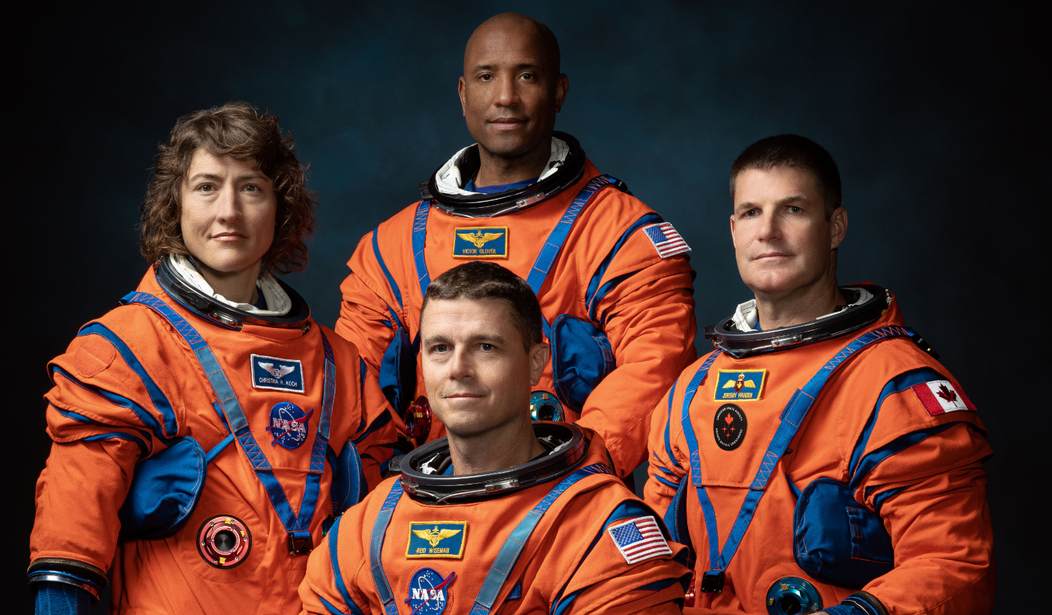
As the Artemis II crew, made up of American and Canadian astronauts, will become the first humans in half a century to fly around the moon, after surpassing the farthest distance men have ever traveled, it marks not only an achievement for them as individuals, but for the United States and for mankind.
A new milestone for humankind: The crew of Artemis II are now the farthest any human has ever travelled, reaching a maximum distance of 252,752 miles from Earth.
— NASA (@NASA) April 6, 2026
This surpasses the previous record set by Apollo 13 in 1970 by about 4,102 miles. pic.twitter.com/DbLFvvdEfT
NASA released a clip from inside the Orion spacecraft Integrity, where the crew was visible, and one, apparently Canadian, Jeremy Hansen, talked about the historic importance of their achievement. “From the cabin of Integrity here as we surpass the furthest distance humans have ever traveled from planet Earth. We do so in honoring the extraordinary efforts and feats of our predecessors in human space exploration,” he said.
Hansen continued, “We will continue our journey even further into space before Mother Earth succeeds in pulling us back to everything that we hold dear. But we most importantly choose this moment to challenge this generation and the next to make sure this record is not long lived.”
This ties in with recent comments from Integrity’s American pilot Victor Glover, who received a question last week from The Telegraph about being the first black astronaut to fly around the moon. Glover had a great response. While acknowledging that “firsts” related to race and sex are important on some level, he quickly turned to emphasizing the importance of seeing this trip as an achievement for mankind, not one limited by certain demographic characteristics.
Glover began, “It is a big question, and I wanna highlight, I guess maybe one facet of this is the tension, I call it. I live in this… you know, this dichotomy between happiness that a young woman can look at Christina and just physicalize her, her passion or her interests, or even if it's not something she wants to do, she can just be like, 'Girl power,' and that's awesome. And that young brown boys and girls can look at me and go, 'Hey, he looks like me, and he's doing what?' And that's great.”
Recommended: Trump Slams Leaker Who Endangered Stranded F-15E Crew’s Rescue in Iran
But before turning his comment into an ideal woke clip, Glover flipped the script. “I love that, but I also hope we are pushing the other direction, that one day we don't have to talk about these first, that one day this is just — And I — Listen to this, that this is the human history. It's about human history. It's the story of humanity, not black history, not women's history, but that it becomes human history.”
NASA pilot Victor Glover CLAPS back after being asked what it means to be the first black man to visit the moon: “It’s the story of humanity, not black history, not women’s history, but that it becomes human history.”
— RedWave Press (@RedWavePress) April 2, 2026
“I also HOPE we are pushing the other direction that one day… pic.twitter.com/0ctJfiWVRE
I might also add that it would be more American to celebrate the individuals for their personal achievements and then to talk about what a great moment this is for our nation. Victor Glover is not just "a black astronaut." He was the pilot of NASA’s SpaceX Crew-1 mission to the International Space Station; he has multiple high-level master's degrees, and now he's piloting the Artemis mission. He is an individual with a unique life story and set of achievements. Mission specialist Christina Koch is not just a "female astronaut," nor are commander Reid Wiseman and mission specialist Jeremy Hansen just white men. What un-American nonsense to talk that way, as if their skin color and sex were their most important defining features, above anything else.
Approaching the near side of the Moon.
— NASA Artemis (@NASAArtemis) April 6, 2026
The Artemis II astronauts have surpassed the record for the distance from Earth at 1:56 ET (1756 UTC). This record was previously set during the Apollo 13 mission when the astronauts traveled 248,655 miles from Earth. The Moon continues to… pic.twitter.com/OapAGgGMex
The classic Star Trek show always opened with a monologue from Captain Kirk that said the starship Enterprise would "boldly go where no man has gone before." That was science fiction, but Artemis II is scientific reality, and we must not reduce it to the narrow limits of woke "diversity" standards. It is much too great an achievement for that.